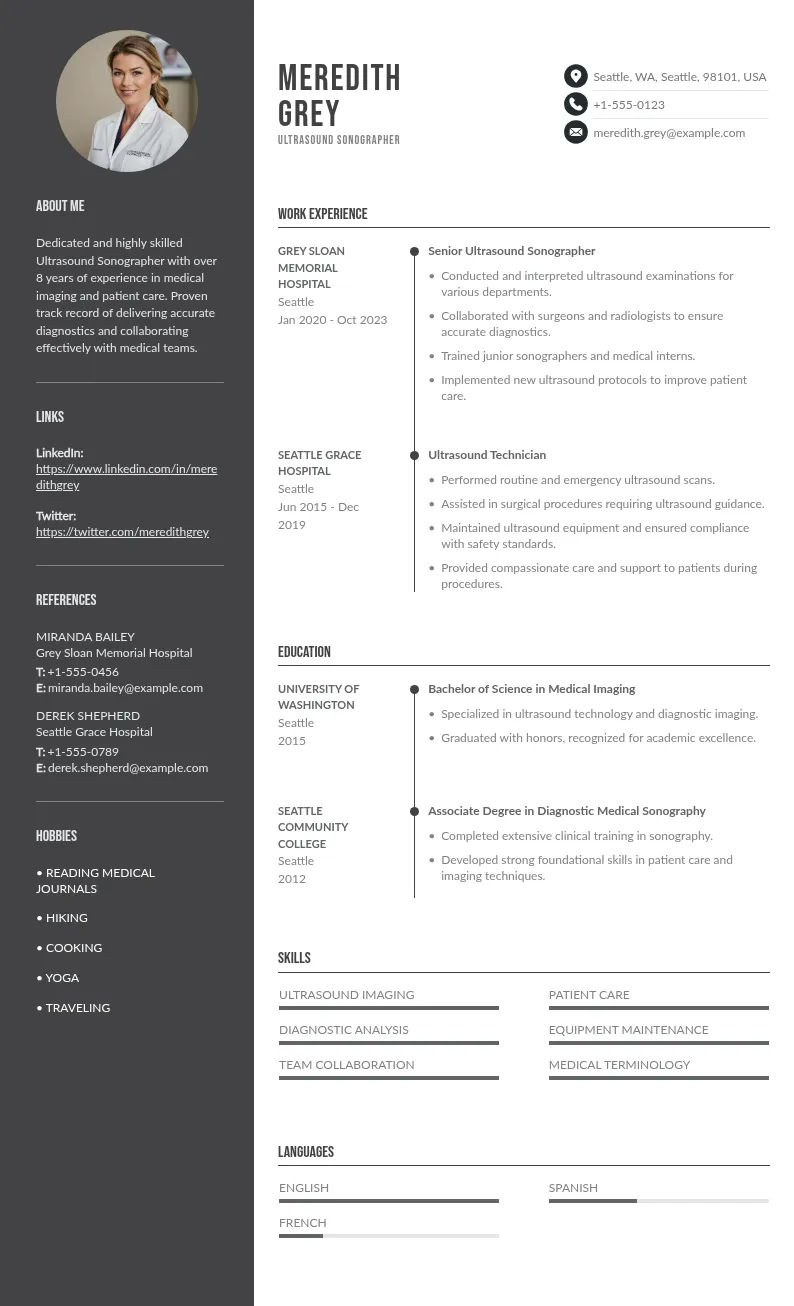


Behind every clear diagnostic image is a skilled ultrasound sonographer. It's a profession where precision matters... and so does your resume. With hiring managers sorting through dozens of applications for a single opening, the way you present your experience on paper often decides whether you land an interview or get passed over.


So what does a winning sonographer resume actually look like? It highlights your imaging expertise, patient care abilities, certifications, and concrete results, etc, all while staying readable for the applicant tracking systems (ATS) most healthcare employers rely on.
This guide breaks down what recruiters want to see, how to structure each section, and which skills deserve the spotlight. A complete resume example is included to help you get started.

Emily Carter, RDMS
Indianapolis, IN
(555) 123-4567
[email protected]
Professional Summary
Registered Diagnostic Medical Sonographer with 6 years of experience performing abdominal, OB/GYN, and vascular ultrasound examinations in hospital and outpatient settings. Recognized for accurate imaging, compassionate patient care, and efficient workflow management.
Skills
Technical Skills
Soft Skills
Professional Experience
Ultrasound Sonographer
St. Vincent Medical Center
June 2021 – Present
Diagnostic Medical Sonographer
Community Health Clinic
August 2018 – May 2021
Certifications
Education
Your work experience should demonstrate your ability to produce high-quality diagnostic images efficiently in busy clinical settings. Show how you contribute to positive patient outcomes. Quantify your achievements whenever possible. This helps hiring managers understand the scope of your experience clearly.
 Instead of writing:
Performed ultrasound exams.
 Write:
Performed 20–30 diagnostic ultrasound examinations daily, supporting timely diagnosis and treatment planning while maintaining high imaging quality standards.
Specify the types of examinations you perform rather than simply stating "ultrasound exams." Depending on your experience, include specialties such as:
Recruiters often look for specialty experience that closely matches the employer's patient population.
Mention the imaging systems and healthcare technologies you use, such as:
Experience with these systems shows that you can integrate smoothly into existing clinical workflows.
Strong resumes emphasize results instead of responsibilities.
Weak:Strong:
Weak:Strong:
Recruiter Insight
Healthcare recruiters often review resumes quickly before deciding whether to schedule an interview. Resumes that immediately highlight specialty imaging experience, daily examination volume, recognized certifications, and familiarity with PACS or EMR systems are generally easier to evaluate because they demonstrate both technical competence and readiness for clinical practice.
Different healthcare employers prioritize different ultrasound specialties. Customizing your resume to match the job description can help both applicant tracking systems (ATS) and hiring managers quickly identify your most relevant qualifications. For example:
Highlight experience with:
Emphasize experience with:
Hospitals often value candidates who have experience performing a wide variety of examinations, including emergency, inpatient, outpatient, and portable ultrasound procedures. Mention your ability to work in fast-paced environments and collaborate with radiologists, emergency physicians, and multidisciplinary healthcare teams.
These employers frequently prioritize efficiency, patient communication, scheduling accuracy, and consistent imaging quality while managing high daily patient volumes.
Healthcare employers and recruiters want proof that you can perform accurate diagnostic imaging while providing excellent patient care. A strong resume should highlight your technical expertise, certifications, and measurable contributions in clinical settings.

They typically look for:
Whenever possible, support your experience with measurable results. For example:
Including these types of accomplishments helps employers quickly understand your technical expertise, clinical efficiency, and overall value beyond routine job responsibilities.
Many healthcare organizations use Applicant Tracking Systems (ATS) to organize and screen resumes before recruiters review them. Including relevant keywords from the job description can improve the likelihood that your resume matches the position.
Rather than adding keywords unnaturally, incorporate them throughout your professional summary, work experience, skills, and certifications where they accurately describe your background.
Common keywords found in ultrasound sonographer job postings include:
Review each job posting carefully and prioritize the terminology used by the employer, provided it accurately reflects your experience and qualifications.
One of the simplest ways to improve ATS compatibility is to incorporate terminology that appears in the employer's job posting—provided it accurately reflects your experience. Ultrasound sonographer job descriptions commonly include keywords related to imaging specialties, certifications, healthcare technology, and patient care.
For example:
Including these naturally throughout your professional summary, work experience, and skills section can improve ATS matching while helping recruiters quickly identify your qualifications.
Creating an effective ultrasound sonographer resume involves more than listing job duties. Employers want to see technical expertise, patient care skills, certifications, and measurable achievements that demonstrate your value in a healthcare setting.
Many healthcare employers prioritize candidates with recognized credentials such as ARDMS certifications and experience relevant to their imaging specialty. Tailoring your resume to each position can improve both ATS visibility and interview opportunities.
Start with a strong professional summary, highlight your imaging experience, include relevant certifications, and optimize your resume with ATS-friendly keywords. By following these strategies and using the example provided in this guide, you can build a professional resume that helps you stand out in the competitive diagnostic imaging field.
Our collection of expertly designed cover letter templates will help you stand out from the crowd and get one step closer to your dream job.