Write your resume in 15 minutes
Our collection of expertly designed resume templates will help you stand out from the crowd and get one step closer to your dream job.


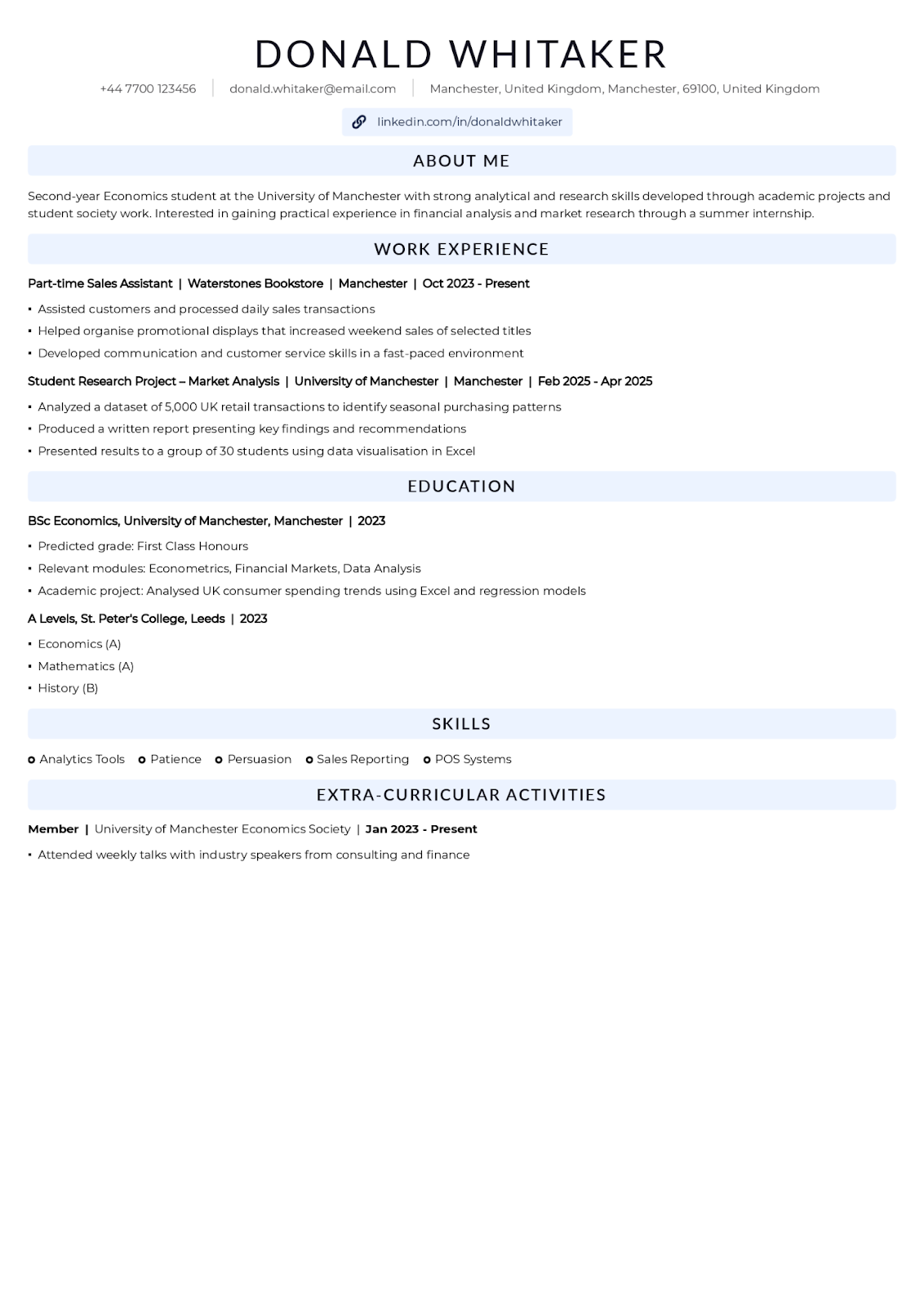
For jobs and internships, structure, clarity, and measurable outcomes often decide whether your resume moves forward. For academic applications, the same document is read more closely, with attention to consistency, effort, and intellectual direction.
So, even for a student, the real question is not only “how to write a student resume in English”, but above all: what to emphasize and how to express it, depending on who reads it...
Why a student resume in English is a different problem from a professional one
Most resume advice in English is written for professionals with years of experience to draw from. The framework is solid: lead with outcomes, quantify everything, use strong verbs, etc. The problem is that this advice assumes you have a track record. As a student, you often don’t, or it’s thin, scattered, and hard to frame.
That’s not a disadvantage you work around. It’s the actual problem the student resume is designed to solve, even for he or she who searches for an internship.
Limited experience in an outcomes-driven format: the core challenge
English-language resume culture, especially in the US and UK, is built around proof !
Recruiters want to see what happened, not what you were responsible for. That standard doesn’t disappear because you’re a student writing a first job resume or looking for an internship. It just means you have to look harder for the evidence, and write more carefully when you find it.
The reassuring part: evidence doesn’t require a corporate job. A semester project, a student association role, a part-time job, or a volunteering stint—all of these can demonstrate real outcomes if you know where to look, and you can even include them effectively by highlighting extracurricular activities in your resume. The writing challenge: extracting them…
Here’s an illustration. Before/after, same student, same experience:
Nothing was invented. The second version simply describes what actually happened, in the language an English-speaking reader recognizes as evidence.
One resume in English, two audiences: How to adapt the same experience
Most students apply to both academic programs and professional opportunities. For example, a graduate program and an internship, or a part-time job and a university exchange. The natural instinct is to send the same resume everywhere. But in English-speaking contexts, this can be costly.
The reason is simple: different audiences read English resumes differently.
- Recruiters (jobs/internships) want to see what you can do now. They scan for actionable results, skills, and measurable outcomes. Phrasing must be concise, active, and outcome-focused.
- Admissions committees (universities/scholarships) want to see your trajectory, effort, and potential. English phrasing should show growth, intellectual curiosity, and academic rigor. They expect clarity, but slightly more narrative context is acceptable.
Same experience, two ways to phrase it in English
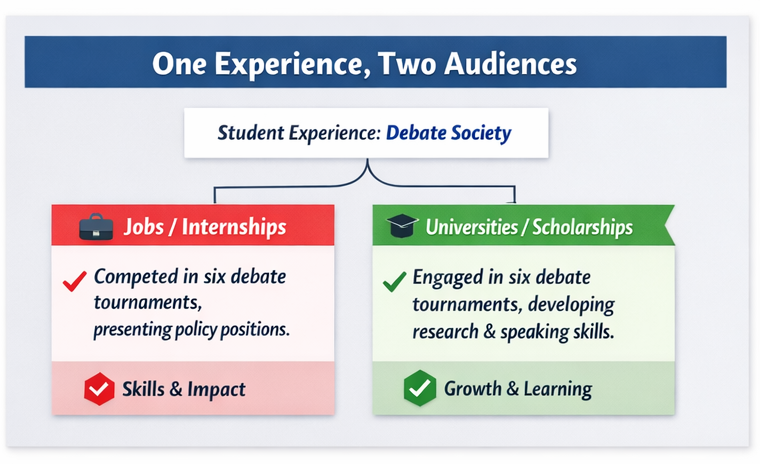
Example: Participation in a student association debate team
- For a recruiter (job/internship):
- For an admissions committee (university/scholarship):
How to reuse the same experience without writing 2 entire resumes
- Start with one core bullet point in English that captures the activity.
- Adjust the phrasing and focus for the audience:
- Jobs → emphasize action, tools, measurable impact.
- Universities → emphasize learning, skills, potential, intellectual development.
- Keep the structure consistent: use the same English-language bullet but tweak verbs and context. This saves time while ensuring each audience reads a version tailored to what they care about.
Writing in English when your CV culture is different: the translation traps to avoid
If you were educated in France, Spain, Germany, Italy, or most of continental Europe, the CV conventions you absorbed are not the same as English-language ones. This isn’t about grammar. It’s about what the format expects, what reads as professional, and what signals that you’re working from a different system...
Phrases that feel natural in French, Spanish or German CVs but weaken an English one
Some constructions translate correctly but land badly. Here are the most common ones, with fixes:
“I am a motivated and rigorous student with a passion for…”
In English resume writing, adjectives that announce your qualities are a red flag. You don’t say you’re rigorous — you show it through the specificity and accuracy of everything else on the page. Drop the opening self-description entirely. Replace it with a two-line professional summary that leads with what you’ve done and what you’re aiming for.
“I participated in / I was involved in / I took part in”
These constructions signal presence, not contribution. English resume culture doesn’t reward attendance — it rewards action. Replace with a verb that describes what you specifically did: coordinated, presented, researched, built, led.
“In charge of” / “Responsible for”
The most common trap. Both phrases describe a role, not an outcome. The fix is the same every time: ask yourself what actually changed, and write that instead.
Listing personal information
Date of birth, nationality, marital status, a photo… it’s standard in many European CVs, but actively discouraged in US and UK ones. Leave them off. Including them doesn’t just look unusual; in some hiring contexts it creates legal discomfort for the recruiter.
Register shift: why academic English and professional English are not the same language
If you write well in English (essays, dissertations, academic papers, etc) you already have a strong foundation. But academic English and professional resume English are genuinely different registers, and confusing them is one of the most common mistakes educated non-native writers make.
Academic English is built for complexity: long sentences, hedged claims, nuanced argument. Resume English is the opposite: short, direct, active, zero hedging. A sentence that would read as sophisticated in an essay reads as bloated on a resume. So be careful when translating your academic achievements (highlighting relevant coursework in your resume is one way to show expertise clearly and concisely).
Compare:
Do’s & Don’ts for student resume in English
5 common misconceptions about writing a student CV in English
1. "Direct translations from my native CV are fine."
❌ "Responsible for assisting customers at the checkout and ensuring their satisfaction."
✅ "Served 80+ customers daily, resolving complaints on the spot and maintaining a 4.8/5 satisfaction score."
The first reads like a job description. The second describes what actually happened. English resume readers want the latter.
2. "Using adjectives proves my skills."
❌ "Highly organized student with excellent communication skills and a proactive mindset."
✅ "Coordinated logistics for a 3-day student conference attended by 400 participants across six universities."
Adjectives announce. Results demonstrate. On an English resume, only one of those counts.
3. "Complex academic English works in a resume."
❌ "Conducted an in-depth investigation into the multifaceted implications of digital transformation on organizational behavior."
✅ "Researched how three companies restructured workflows after adopting new digital tools — findings presented to a faculty panel."
Academic writing rewards nuance and length. Resume writing punishes both. They are different registers, and confusing them is one of the most common mistakes educated non-native writers make.
4. "Passive voice is acceptable."
❌ "A social media strategy was developed to increase engagement for the student association."
✅ "Developed a social media strategy that grew the student association's Instagram following by 60% in two months."
Passive constructions hide who did the work. Active voice makes it unambiguous — and in English resume culture, owning your contribution matters.
5. "My native sentence structure translates naturally."
❌ "During my internship period, I have been in charge of the redaction of weekly reports."
✅ "Wrote weekly progress reports summarizing team deliverables for a supervisor overseeing five projects."
Three problems in one sentence: present perfect where simple past belongs, "in charge of" instead of a verb, and "redaction" (a false friend — it means editing in English, not writing). The fix is always the same: one verb, one outcome, no filler.
Create your resume with the best templates